
#10 Multipotential Thinking in an Age of AI and Talent Futures
Why cross-domain thinking matters when there is no single “right” future

I’ve always liked scenarios.
Not predictions — but structured ways to think about uncertainty.
In January 2026, the World Economic Forum published an interesting scenarios paper titled “Four Futures for Jobs in the New Economy: AI and Talent in 2030.”
It’s not a forecast.
It’s a map of possible futures — grounded in signals we already see today.
At the core of this work is a simple matrix with two axes.
One reflects the speed and depth of AI development, from gradual to rapid.
The other reflects workforce readiness — how prepared people, skills systems, and institutions are to adapt.
Where these two dimensions intersect, they form four possible futures of work.
And this framing matters.
Because when futures multiply, stability doesn’t come from choosing the right scenario.
It comes from building internal adaptability.
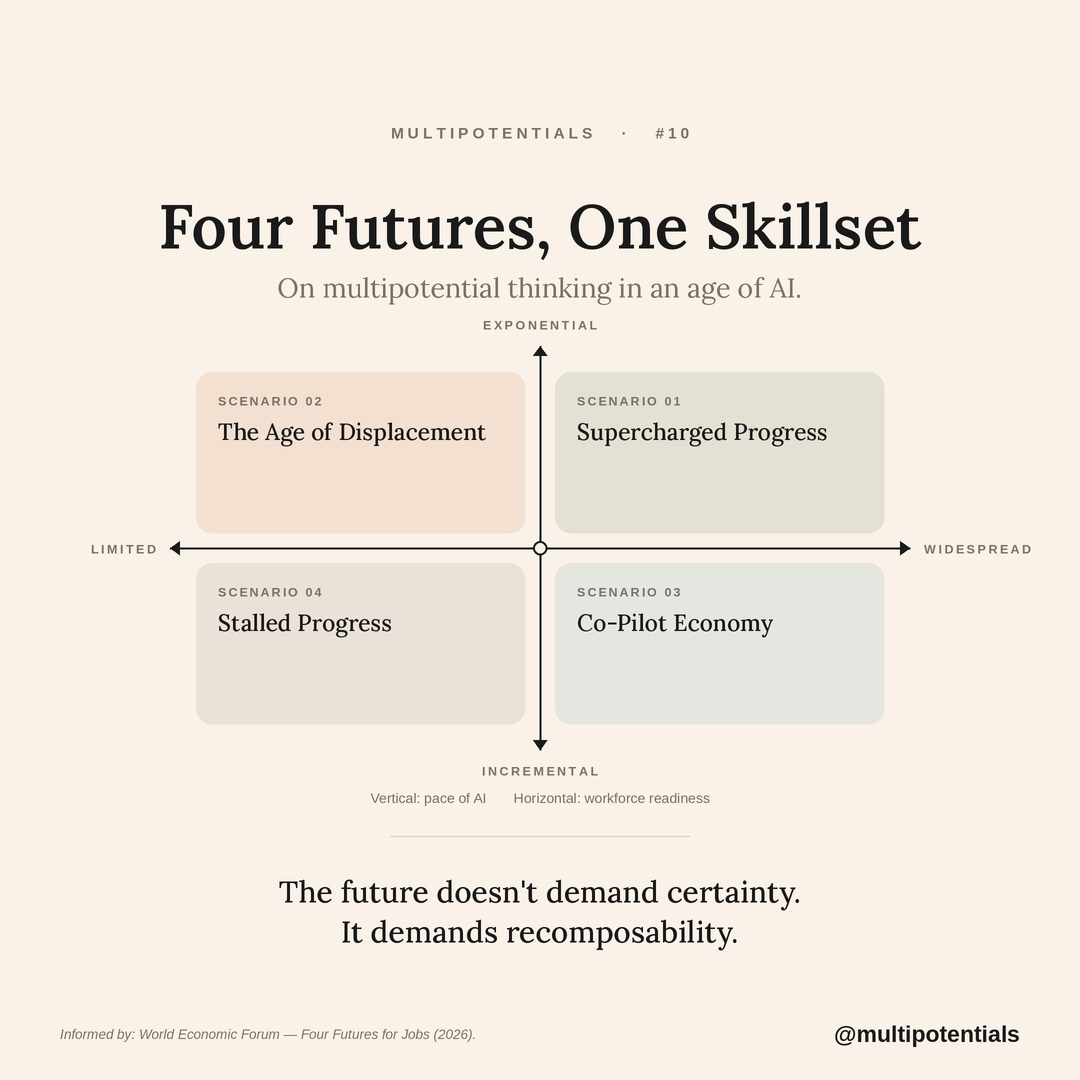
Four futures — one shared signal
The four scenarios differ in pace, tension, and outcomes.
Some assume fast AI progress with strong human adaptation.
Others show rapid technological change combined with low readiness.
Some imagine a slower, more incremental transformation — with very different consequences depending on how prepared people are.
But what struck me is not how different these futures are.
It’s what they all require from people who want to stay relevant.
Across all scenarios, value shifts away from:
fixed roles,
single-track careers,
narrow definitions of expertise.
And toward:
transferable capabilities,
modular skill systems,
continuous self-reskilling,
the ability to move between contexts without losing value.
Why does this connect to multipotentials?
When I read this report, I had a familiar thought:
Many of the approaches described here are already how multipotentials operate.
Not as a personality trait — but as a structural way of navigating complexity.
Multipotential thinking is not about doing many things randomly.
It’s about:
building vertical depth that can travel across domains,
working with modules of value, not static job titles,
learning in parallel directions — and letting them reinforce each other,
designing careers as systems, not ladders.
In a world where:
professions have shorter lifespans,
roles are constantly redefined,
and scenarios diverge instead of converge,
This mindset stops being optional.
A practical reflection
You don’t need to call yourself a multipotential to benefit from this.
But it may be useful to ask yourself:
Which of your skills are transferable across contexts — and which are locked into one role?
Where are you building depth that can travel, not just expertise that expires?
If the scenario shifts — could you reassemble your value in a new configuration?
The future doesn’t demand certainty.
It demands recomposability.
And that’s what this project keeps returning to — not predicting outcomes, but staying coherent across multiple futures.