
#11 The Word Pattern That Shapes Your Writing Across All Roles
How multipotentials can find the invisible thread that connects very different voices

When you’re a multipotential, you naturally write on very different topics.
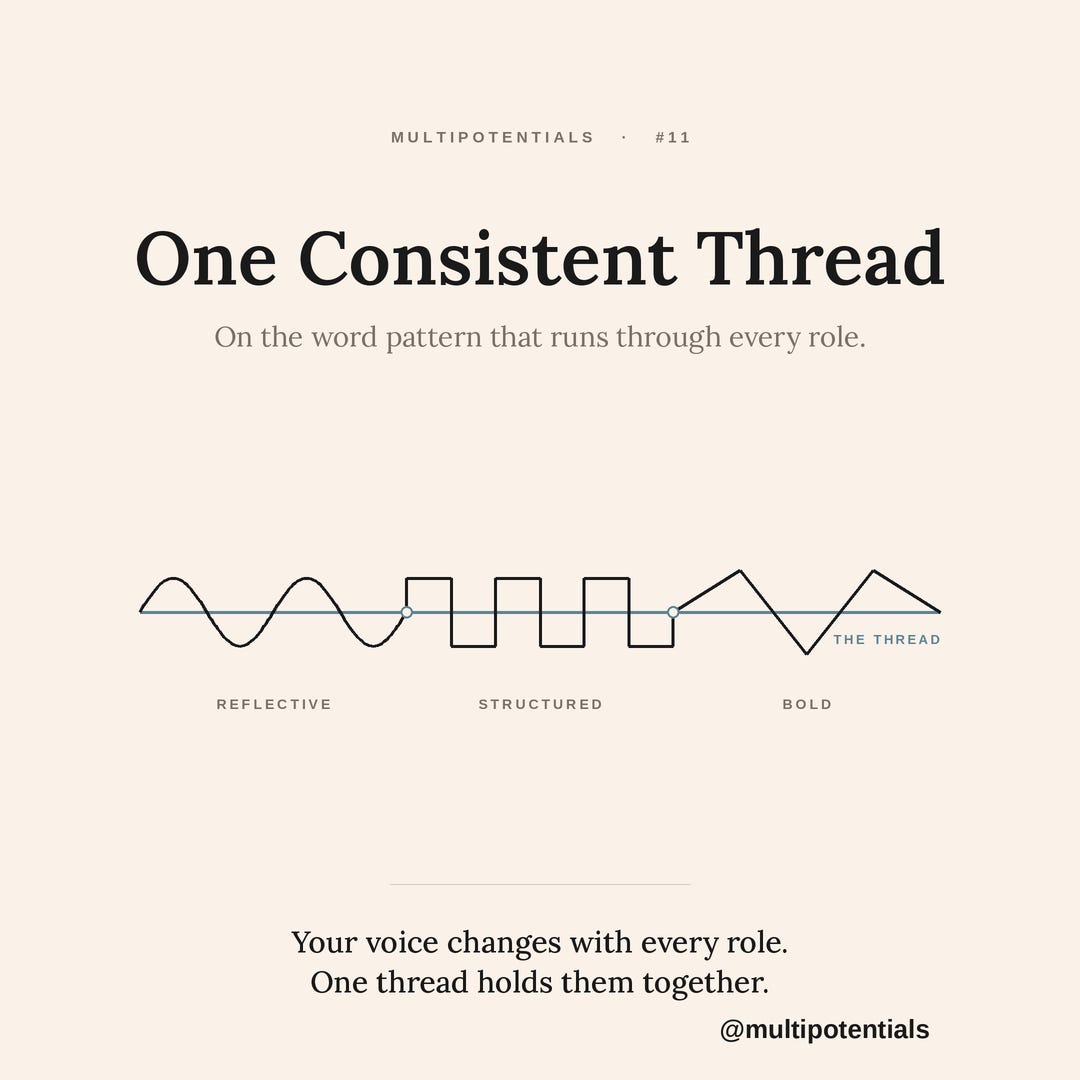
Some projects are reflective.
Some are structured.
Some are bold and open.
So when people ask, “What’s your writing style?” — you might want to reply:
“Which role do you mean?”
It can feel a little like creative schizophrenia — but it’s simply part of the architecture of a multipotential life.
Years ago, during a writing workshop, we had an exercise: describe the same scene using only one type of word — either nouns, adjectives, or verbs.
You had to choose one.
Only I from the group chose verbs.
After reading my piece, the group and the teacher said:
“You are a verb person. When we read your text, we want to get up and do something. There is movement in every line. It’s about action.”
That comment stayed with me.
I didn’t choose verbs consciously — they just came naturally.
Later, I realized: verbs are my form. My word shape. The element I carry into all kinds of writing, even when the tone changes.
Later, I came across a quote in a magazine:
“Verbs are the great conductors of text. They speed it up or slow it down, but they never — never — stop it entirely.”
It made something click.
Many writers have a similar throughline in their work.
For me, it’s action.
For you, it might be imagery, rhythm, contrast, silence, or dialogue.
Interestingly, when I analyzed fiction authors, I noticed that writers who rely heavily on verbs are sometimes dismissed as “light” or “empty.”
But that’s not a weakness.
It’s simply a different artistic choice — one that values movement over stillness.
Your style is not an accident.
It’s an art form.
And across the ecosystem of your roles, it can become the invisible thread that ties everything together.
Try This: Find Your Own Throughline
Pick a simple theme — a morning routine, arriving somewhere new, learning something for the first time.
Now experiment:
Change the word focus. Center your sentences first on verbs, then on nouns, then on adjectives.
Change the structure. Write one version in long flowing sentences, then another in short sharp lines.
Change the texture. Add more dialogue. Or more description. Or more inner reflection.
Notice what feels natural — not forced.
It might be a word type.
A rhythm.
A way of framing moments.
That’s your author’s fingerprint.
The element that can travel across all your roles and projects without forcing them into the same tone.
Your multipotential writing doesn’t need to sound identical everywhere.
It just needs one consistent thread that holds the ecosystem together.