
#14 How Structure, Flow, and Stillness Create a Multipotential Rhythm
On my experience combining discipline with shifting modes across multiple roles and projects

When people picture multipotentials, they usually picture creative chaos — many directions, many roles, many beginnings at once.
But what rarely gets talked about is what makes that system actually hold over time.
Discipline.
Because without it, nothing stays connected.
No system holds.
No project grows.
No role fully unfolds.
For a long time, I thought of discipline and creativity as opposites.
Now I see them differently.
Discipline isn’t the opposite of creativity — it’s its rhythm section.
In a multipotential life, it holds multiple tracks at once — projects, roles, identities — so they don’t collapse into noise.
It sets the beat, so your curiosity can improvise.
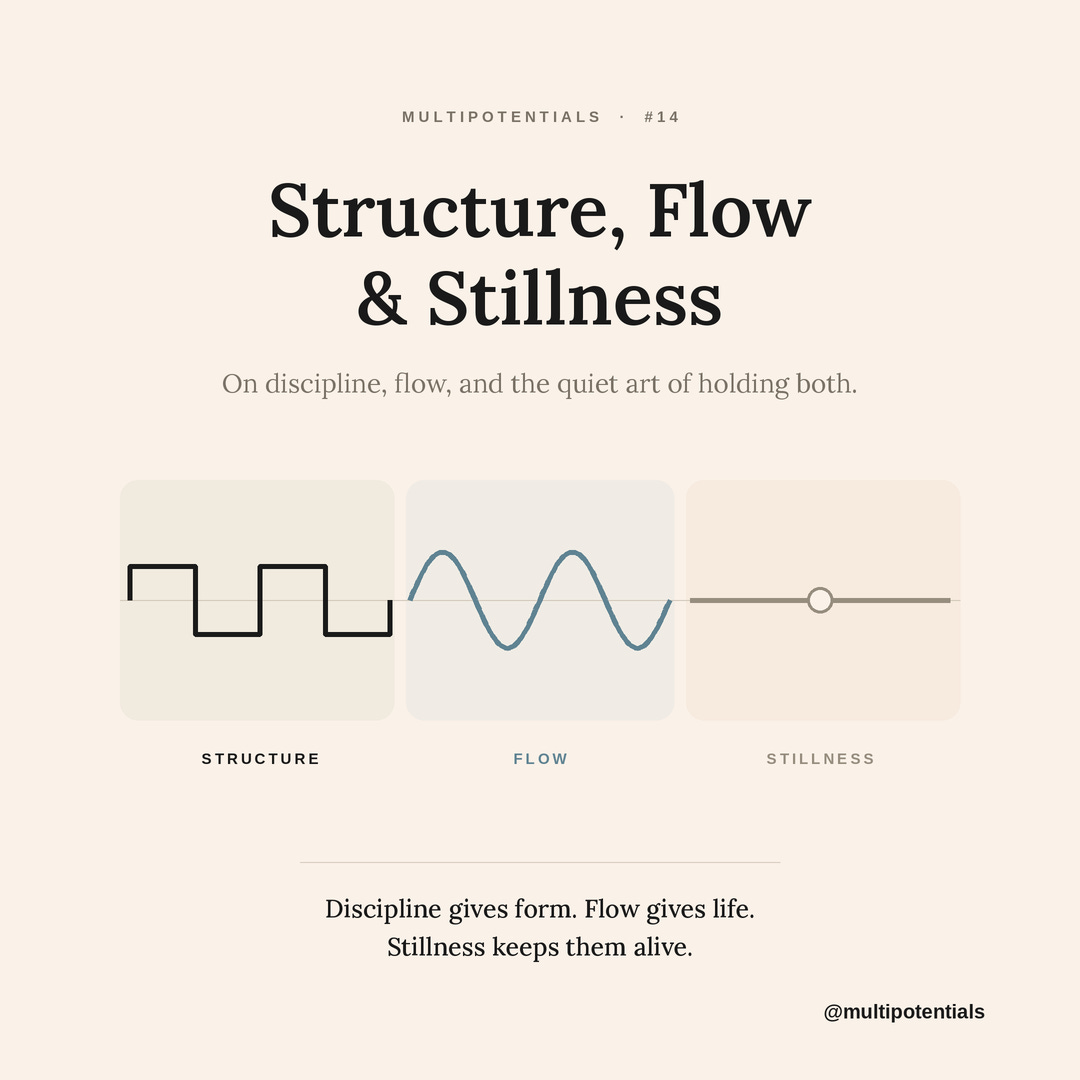
The balance point
But here’s the nuance.
Too much structure, and you lose spontaneity.
Too much flow, and you lose direction.
Somewhere between the two lies the balance point — the quiet line where order meets openness.
That line moves. It’s never fixed.
And finding it, again and again, is part of the work.
Routine as architecture
For me, this balance also includes routine.
I’ve come to love it — not as a limitation, but as architecture.
A well-designed routine doesn’t confine me.
It gives me rhythm to create.
And more importantly — rhythm to switch between different versions of myself without losing continuity.
It’s the invisible frame that lets movement happen.
The case for doing nothing
And then there are the other days.
Days of deliberate idleness — moments of not-doing, when I let ideas drift.
For a long time, these felt like wasted time.
They aren’t.
Psychologists call this incubation — the period when the mind wanders freely and makes connections that focused work rarely allows.
Neuroscience points the same way: during rest and mind-wandering, the brain’s default mode network comes alive — the same system tied to imagination, insight, and creative problem-solving.
Researchers Jonathan Smallwood and Jonathan Schooler describe mind-wandering not as lost attention but as a meaningful mode of cognition linked to spontaneous thought and mental time travel — in which the mind moves between past experiences, present concerns, and possible futures.
For multipotentials, this is often where connections happen between unrelated domains — where one identity informs another.
So now I protect these days.
The ones where I’m not producing, not planning — just being.
And often, that’s exactly when the best ideas arrive.
What my balance looks like
🕐 Dedicated time blocks for core projects.
🌊 Free, unstructured space for synthesis across different roles and ideas.
🌤️ Days of intentional stillness, where imagination rebuilds itself.
🔁 Periodic reviews, where I realign structure and flow again.
Holding many lives in rhythm
Discipline gives form.
Flow gives life.
Routine keeps them in motion across different parts of yourself.
The art of being a multipotential isn’t choosing between structure and flow — it’s learning how to move between multiple flows without losing yourself in the transitions.
Your balance will look different from mine.
And that’s exactly the point.
It’s not a rule to follow.
It’s a rhythm across many lives you are already living.
📚 Reference: Smallwood, J. & Schooler, J. W. (2015). “The Science of Mind Wandering: Empirically Navigating the Stream of Consciousness.”